I Love You, I'm Still Here
Homo sapiens: pink and squishy, pathetic in tooth and claw. We’ve only ever been able to hold our own in this world by way of our collective wiles and the technology begotten by them. Because of this it’s only natural that we crave the comfort of others on a bone-deep level.
Small children are quite literal about the urgent equation of the physical presence of others with safety. When Mama, Papa, or whoever leaves the room, to hear the little one’s wails you’d think the caregiver had been shot into outer space. As a child grows, they typically learn how to internalize this love and support in a basic trust in the world and their own ability to navigate it. But if they don’t learn this, the primal sense of being alone, unsafe, and unable to cope can be overwhelming.

This is what we want.
If someone doesn’t learn how to self-soothe by the time they reach adulthood it can exhaust and damage their relationships. Gnawing need can ratchet up to a boiling point of desperation and even reactive anger with the person for not being available. This storm of emotions isn’t always triggered by partners, family members, or inner circle people, either. I’ve heard many people describe panicky attempts to gain contact with someone, almost anyone. They’ve reached out to all their friends and haven’t heard back. It’s not just about wanting to know you’re secure with a partner, it can also be about just knowing that you have people at all.
The archetypical enactment of relational anxiety in our era is the series of increasingly frantic texts, calls, emails, messages…if passenger pigeons or smoke signals were more accessible, perhaps we could add those to the list. The content of these typically revolves around asking where someone is, why they won’t respond, if they’re with someone else, where are you, where are you, why aren’t you here and what does it mean that you aren’t? I’ve had many, many clients describe how distressing this can be both from the perspective of the person seeking contact, but also as the person being bombarded.
(Cue Lady GaGa’s “Telephone”, a song about why it’s exhausting to have someone call you 50 times in a row)
In the early 1950s French child psychologist Jean Piaget gave us one theoretical stepping stone for understanding this experience. Piaget described a concept called “object permanence,” the developmental cognitive milestone in which the child is able to comprehend an object’s physical continuity even when the object is hidden, removed, or otherwise out of sight. Piaget would demonstrate a baby’s level of object permanence by hiding a toy under a blanket, and then observing if the child searched for the toy.
Contemporary psychoanalysts, true to form, were off to the races with the idea. By 1952 Heinz Hartmann in Germany defined “object constancy” as a person’s ability to know and internalize that important people still go on existing, even if not before our eyes. In the 1960s and 1970s physician and psychoanalyst Margaret Mahler further developed the idea within her body of work on child development and healthy separation and individuation, coming to the conclusion that developing object constancy is crucial for individuals to form not just meaningful relationships but also a stable sense of self as they grow.
Jean Piaget cosplaying a deranged leprechaun
Also in the 1960s and 1970s, a new arena of child development research called “attachment theory” was picking up momentum; and it would grow to be one of the most widely accepted psychological theories of our time. While attachment theory defines four main relational styles, people with what is called an anxious attachment style in particular struggle with object constancy.
These individuals typically grow up with inconsistent caregivers who are sometimes available for emotional nurturance and care, but at other times and without any pattern that the child can make sense of; dismissing, irritated, or just not present at all. Instead of gaining confidence that a secure base will be there if they need it, a child with an anxious attachment style learns to be hypervigilant as to whether their loved one is available to them; and develops a range of strategies including people-pleasing and constant reassurance seeking to manage this anxiety.
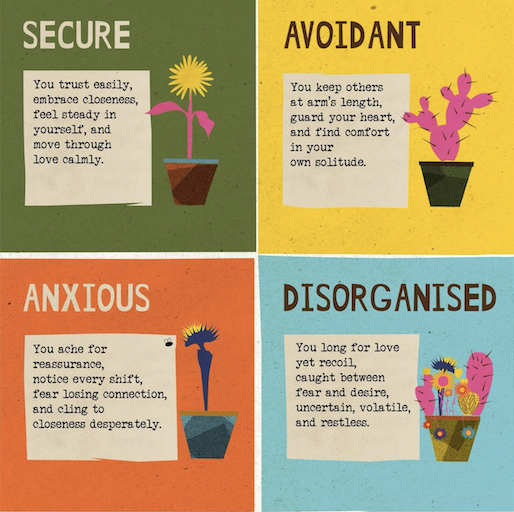
Credit to Mike Cooper and Xabier Lopez for this lovely and succinct infographic on the four main attachment styles.
And because I’m me, I can’t resist throwing in a little existential theory to spice the pot. Existential analysis distinguishes two categories of felt security people experience in the world, “basic trust” and “fundamental trust.” Basic trust is identical with the relational security discussed by the theorists above, when a person has learned to trust people to be generally reliable and in a basic sense, “good.” Fundamental trust, however, is something even more elemental. Fundamental trust refers to the trust and ease that a person has in the world itself.
With fundamental trust a person feels that there is a bedrock structure and order to life that can be relied upon, even if one cannot control or even always understand it. This principle is conceptualized by some as God, the laws of nature, the universe, or life itself; and it can be experienced by atheists and agnostics as well. With fundamental trust I feel that even if I die, even if apparent chaos descends, this basic order supports me and persists in itself. I can trust this ground of being that I stand upon.
The philosopher Martin Heidegger wrote about basic trust, but the idea also shows up in Buddhism, particularly in the Zen tradition. Attachment theorists have made their own contributions with a coterie of research exploring how people can experience this fundamental trust in a deeper structure itself as a secure attachment, with the same attachment benefits as a secure human figure.
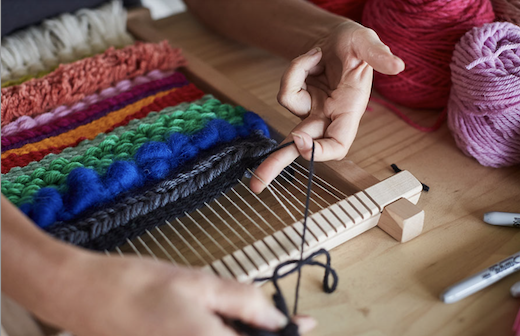
When I think of fundamental trust, I think of how the single threads of a tapestry are held in place, bound into a stable field together and by one another.
How do you work on relational anxiety?
Even if you tend anxious in your relationships, even though it started in childhood, you are not trapped in your history. In the 1980s, attachment researcher Mary Main identified a large category of adults (up to 33%!) whose attachment experiences as a child would seemingly predict an insecure attachment style, but who still showed all the hallmarks of secure attachment. Main and her colleagues dubbed this phenomenon “earned secure attachment,” the ability of an adult to rewrite their early programming and learn how to be in relationships in a more gentle, less reactive way.
Earned secure attachment demonstrates that it is possible to change how you habitually relate to people. You must be willing to carefully watch your own patterns, be curious, and do the stubborn work of shifting the familiar grooves of habit towards something else. It’s simple but not easy.
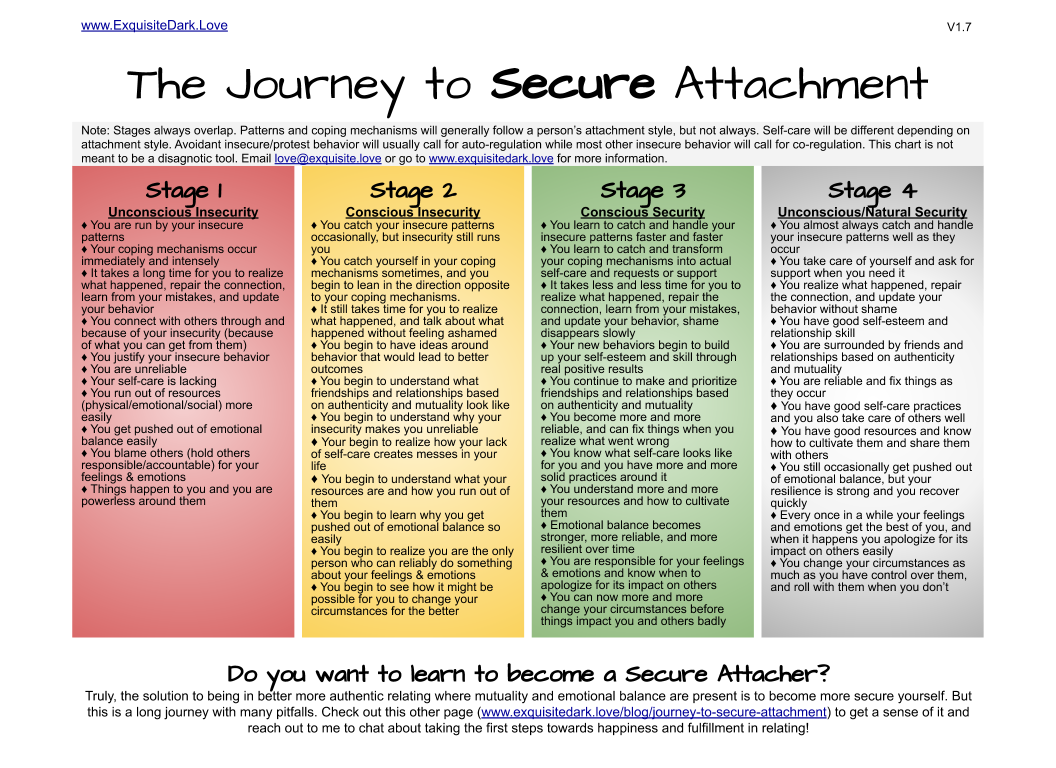
Dense but information-rich graphic summarizing how someone moves from insecure to earned secure attachment.
For example, if someone is unavailable, perhaps you recognize that feeling of desperate need for reassurance and the commensurate urge to call or text a second (third, fourth, fifth, bajillionth) time. This time, though, you manage to take a pause. You notice the internal experience of anger at them for leaving you hanging, fear that you will be left alone, sadness that this feels like it has happened so many times and is so huge that it might swallow you into the earth itself. This moment of noticing must include gentleness and empathy for yourself, as well. Of course you feel rage, fear, sadness, etc., given what this moment feels like and what it means to you, and with the full weight of the past behind it.
This pause might also include some kind of activity that gives a chance for the chemical drivers of desperate self-protecting action to flush out from your system and, even more importantly, gives time for your prefrontal cortex to engage. The prefrontal cortex is the part of your brain associated with reflection, values orientation, and long-term planning and goal identification, such as “I don’t want to push this person away. Let me see if there’s a better way to deal with my hurt and my fear that they don’t care about me as much as I care about them.”

One of the Twelve Labors of Hercules led to him actually moving a whole ass river to clean out the Augean Stables. This is the image I have for both how ponderous and momentous changing our relational habits can be.
If you can create this moment to breathe, it becomes that much easier to see the situation with some clarity and perhaps even to get curious about the other person. Could they be busy? Are they overwhelmed with other things in their life? Do they have an avoidant side that makes them shut down in the face of difficult things?
With the help of a pause we can learn to choose a different response. Instead of continuing to alternately call them and ruminate about where they are, what would help you self-soothe and feel less alone? Typically this is something centered in self-care that tends to your need to slow down and reground, like walking, spending time in nature, reflective writing, or whatever you personally know helps you to regulate.
One of the most creative examples I’ve heard from a client is gift-giving. When this client feels anxious in a relationship despite the outward signals that “all is well”, they like to to go out and see if something small catches their eye for their friend or partner. This flips the script, taking the care about the relationship that is at the heart of relational anxiety seriously, but turning it into a gesture that can be experienced by the other as care rather than need and control.
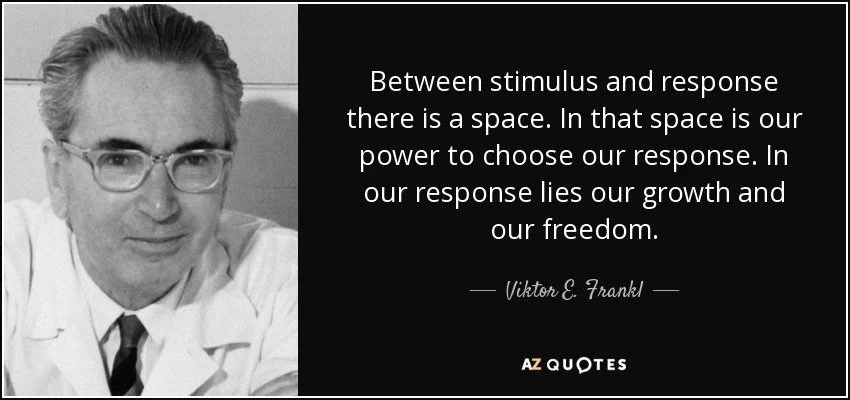
I’m condensing down into a few paragraphs what can take months to practice and years to perfect. Your emotions will get the better of you and convince you that you are not ok and that a pause is too long to wait. You will not always avoid being sucked into the triggered state that, once present, takes time and rest to dissipate. This work of rewriting your patterns is not fast but it does work, and therapy or another reflective practice can help.
We humans like to think we know what’s going on. With relational anxiety, when the signs are ambiguous we quickly conclude that this person doesn’t really care, they can’t be relied upon, and the whole house of cards is crashing down. Then to make sure we know what’s going on, we knock it down ourselves. Perhaps the answer, instead, is to have a little more object constancy and a little more trust in the other. Just because the person isn’t in front of us, doesn’t mean they have truly left us alone.