Missing the Point: Meaning-seeking, phenomenology, axiology, and other high-falutin’ words that I promise I didn’t make up
I’m pretty sure my ancestors would have been deeply confused at my life. I imagine them sometimes, cocking an eye at me and asking, we survived all those starving winters, all those epidemics and pogroms and sea voyages…for you to do what exactly? Why don’t you have twelve children and are as fat as a cow? Why don’t you farm the land in front of and behind your house and spend the rest of the time reclining on cushions in the company of said twelve children (and at least a few grandchildren by now)? And then pretty quickly I conclude, nuts to the ancestors.
Our lives would make little sense to people only a few generations past. Hell, at times we ourselves struggle to understand them. In a complex society, in an era of unprecedented choice, we are free to forage new nuts to crack beyond bare survival. But this freedom to commit ourselves in any direction we choose is also downright confusing. If we’re not just surviving, if in fact everything’s great on a material level at least, then what the heck are we supposed to be doing with our time on planet earth?

What’s the g-d all-fired point, consarnit? I don’t know why I’m talking like Yosemite Sam except it adds the right flair of exuberant ignorance.
The question of meaning takes on new poignancy in modernity. After all, throughout much of human history, meaning was found by fulfilling one’s place in the natural order of the world. This generally meant living in accordance with the perceived will of God or the gods, and carrying out the social role you were born into within a community you would live in your entire life. For us moderns, however, change is a constant and individualistic agency is our underlying assumption instead. What we are born into is just a starting point. And if a starting point has freedom of movement on all sides, what direction do we choose?
First, let’s do a little disambiguation of the word “meaning.” There are two different levels of what constitutes the meaningful. The idea of some kind of cosmic objective waiting to be uncovered is what is known as “ontological” meaning. For those of us who don’t subscribe to an authoritative religious code, there’s no real answer to this one. Instead, what we humans have to work with is what is called “existential” meaning, referring to the meaning we find for ourselves in the happy hunting ground of our real lives. Like the poet Rilke famously urged his young correspondent, we are called upon to love the question itself of meaning. Our only recourse is to take a personal process of constructing a response, rather than trying to uncover a preexisting meaning that we can then strive for.
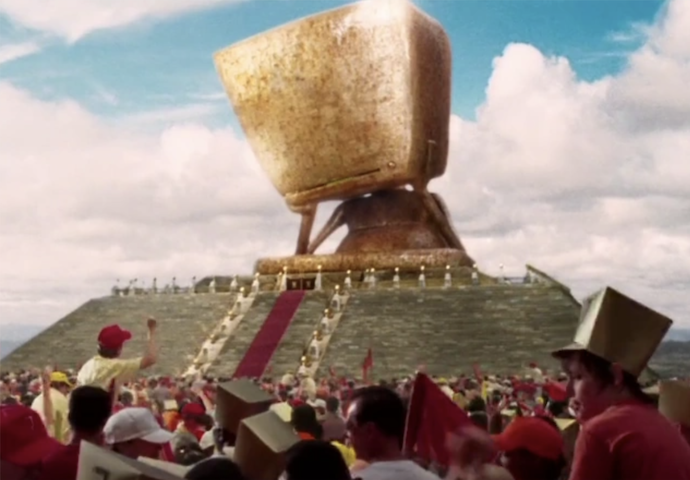
Douglas Adams beautifully lampoons the human pursuit of meaning in his book the Hitchhiker’s Guide to the Galaxy. In it, the supremely powerful supercomputer Deep Thought spits out (after millenia of anxious waiting) the answer to Life, the Universe, and Everything. It was, of course, 42. When the programmers displayed their confusion and frustration, Deep Thought told them they hadn’t properly understood the question and that the construction of another supercomputer (and another few millenia) was required to do so.
Another concept essential to our understanding of meaning is “values.” If meaning is the fulfillment we get from something being worthwhile, values are the concrete actions and objects we pursue in order to get that feeling. The word for systems of values and their study is axiology. You can think of values as abstract concepts like Kindness, Knowledge, Creativity, etc., ie categorical principles that we pursue. Other approaches take a more process-based approach by defining values as a particular action-in-context, such as “spending time with my son” or “becoming excellent at writing.”
The author and psychiatrist Viktor Frankl gives us one of my favorite simple axiologies, with his division of meaning into 1. creative values, 2. experiential values, and 3. attitudinal values. Creative values refer to what we make, whether that be a work of fine art or something more down-to-earth, like creating a pleasant home environment or a useful system of protocols for a work team. Experiential values refer to what is valuable in encountering our world, such as natural wonder or gaining knowledge, as well as experiencing human relationships. Attitudinal values point to the meaning of how we respond to suffering in our lives, including cultivating dignity and authenticity in the face of them.
Many philosophers including Aristotle, Immanuel Kant, John Stuart Mill, and Max Scheler have proposed their own axiologies to understand what the best way to act in our world is. Prefab axiologies can inspire and guide us, giving us the vocabulary to identity and understand what we know to be meaningful; but I find a more personal, experiential approach to be essential for my clients and myself.
Underlying this second way of determining values is a phenomenology of the self as it encounters the world. Phenomenology is the deliberate study of lived experience, a kind of deconstructing approach to exploring and describing what life and its contents feel like on a basic level. While simple in its basic concept, phenomenology is demanding in its insistence that we put off at first or “bracket” our preexisting understandings, connections, and assumptions in order to truly understand something.
For more on phenomenology check out this previous blog post.
The phenomenological approach can be applied to one’s own internal world and its emergent swirl of thoughts, emotions, drives, wishes, needs, etc. The assumptions we are bracketing in this case are the tendency we have to swoop in and cut off this evolving process with judgment, dismissiveness, shame, inferiority, and paralyzing anxiety. Phenomenology calls on us to take our subjectivity sensitively and seriously, and be open to surprising ourselves. Implicit in this approach is that meaning is rarely a monolithic single thing, but is composed of a hundred small encounters with people and things we care about throughout the day.
The person who most elegantly explicated a modern self-directed phenomenology was the philosopher Eugene Gendlin. Gendlin developed a process-based method called “Focusing” in the 1960s and ultimately published his book Focusing in 1978. Focusing brought the philosophical attitude of phenomenology to the arena of self-help and personal growth. While he maintained his primary academic and intellectual identity as a philosopher throughout his life, Gendlin studied closely with, was deeply influenced by, and influencing of, the granddaddy of humanistic, person-centered psychotherapy, Carl Rogers. If you’re ever glad your therapist is not authoritatively telling you what your issue is in Freudian terms, is instead (radical at the time!) listening to you and curious about your own ideas about your problems, you have Carl Rogers to thank.
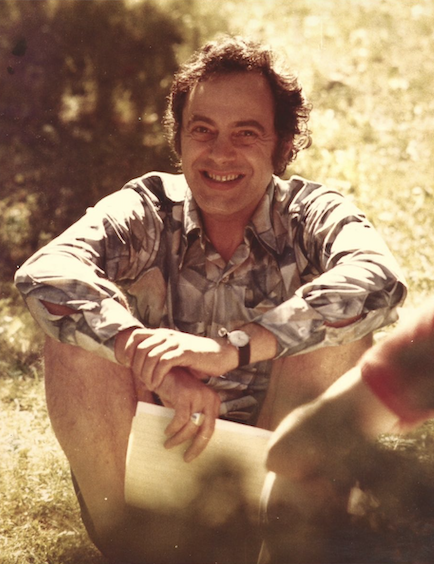
Eugene Gendlin in 1978, looking real wholesome and like he’s leading a hike or something.
In Gendlin’s focusing, participants seek to move past stuckness by following a series of steps to guide phenomenological self-inquiry. In short, this process emphasizes bracketing one’s intellectual discourse around a thorny issue, attending to one’s bodily felt sense, finding “handles” ie words or images to help one hold on and converse with that issue, and gentle questioning of that stuckness as represented in the body sense and handles.
To pursue your own inquiry around meaning and values, focusing is just one model you might explore. Existential analysis has a number of its own frameworks for phenomenological inquiry specifically around meaning and values. If you want to try it out on your own before delving deeper into any of these more formal approaches, you might start by asking yourself a few questions that you can combine with a phenomenological approach.

"The body is not a thing, it is a situation: it is our grasp on the world and our sketch of our project" - Simone de Beauvoir
For example, when in day-to-day life do you encounter flickers of meaning? These are promising directionals even if they don’t feel quite “there” or fully formed. How can you investigate these further, invest a little more as an experiment and see if there is more there for you? Another question my clients sometimes find useful is, what was different in other eras of your life when you had a sense of meaning, and what shifted when life lost that meaning?
A caveat: this process is more complicated when you are depressed. Depression has a way of scrambling the instrument panel and paralyzing the very sensors we need to find and feel meaning. It can make something that one knows on a bone-deep level to be meaningful (e.g. one’s kids or partner, one’s work for a social good) feel stupid and flavorless. Paths of self-inquiry like the ones above are still useful, sometimes even crucial, for depression recovery when someone lacks meaning, but they work best when combined with an explicit focus on depression recovery itself.

Sometimes when I’m trying to understand what draws me, the image of a dowsing rod comes up. These traditional (and to be frank, discredited) tools were said to point the way to water by bending in its direction, in a kind of “hot and cold” game.
Meaning is ever-shifting and often elusive, asking us to recommit to its pursuit as a value in itself. If you made it this far, it’s probably because a sense of meaning in your life is important to you. Sometimes we discover ourselves bereft of meaning after seeing something through, or we wake up to the realization that things that were once meaningful no longer have the same magnetism. The spell is broken and we are asked to start again. This is not catastrophe, this is not failure. This is just one more way life insists we live it in real time rather than ever being so arrogant to think we’ve ever finally figured it out.
Below: a pop-punk song that I associate with Frankl’s idea of “attitudinal values.”